



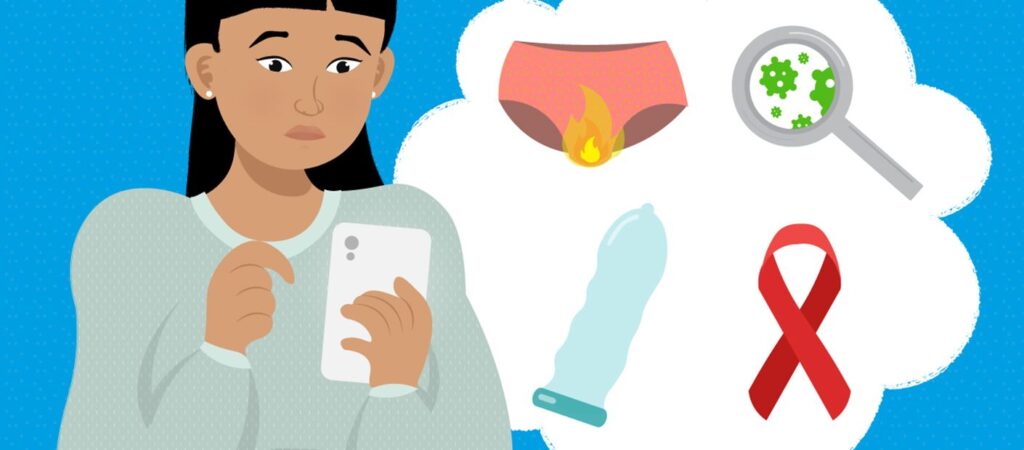
If you’re worried you’ve caught a sexually transmitted infection, you won’t be alone. Before you start to panic, read on to find out what to do.
Sexually transmitted infections (STIs) are very common. Some STIs have symptoms – for example, you might notice a a rash or an itch – but others have none at all.
The good news is most STIs are treatable, especially if you catch them early.
How will I know if I have an STI?
The truth is, you might not.
Lots of people don’t know they have an STI. That’s because some of the most common ones don’t give you symptoms, or the symptoms may take a while to show.
So if you think you might have been at risk of catching an STI, the only way to be completely sure is to have a test. You can have STI screening at any MSI Tanzania facility – visit your nearest clinic to get checked out.
STI symptoms can differ between men and women. These are the common symptoms you may experience if you have an STI:
Women
- Yellow or green vaginal discharge
- Discharge that smells
- Bleeding between periods or after sex
- Pain during sex
- Lower tummy pain
Men
- Discharge from the penis
- Irritation of the urethra (the tube wee comes out of)
Both women and men
- Pain when you wee
- Itching, burning or tingling around the genitals
- Blisters, sores, spots or lumps around the genitals or anus
- Black powder or tiny white dots in your underwear – this could be droppings or eggs from pubic lice
When should I get tested for an STI?
If you’ve had sex without using a condom, you could be at risk of having caught an STI. This includes vaginal, anal, and oral sex. Some STIs can also be passed on through touching genitals or sharing sex toys.
Come and visit our clinic as soon as you can so you can get checked out, as STIs are much easier to treat early on. If you don’t get treatment, the STI could cause more problems with your health later down the line – it could even affect your fertility.
You might feel anxious or embarrassed about coming to us; it can feel like a big deal. Remember, we do these tests all the time and we will never judge you.
The important thing is that you find out if you have an infection. If you don’t have an STI, you’ll feel relieved. But if you do have an infection, it’s much better to know and start treatment, rather than to ignore it.
When you have your STI screening with us we can also discuss contraceptive options so that you’re protected in the future.
The most common STIs and their symptoms
Chlamydia and Gonorrhoea
Chlamydia and Gonorrhoea infections are both easily treated – but without treatment they can spread and become more serious and painful.
The symptoms of these infections are similar:
- You may bleed after sex or in between periods
- Sex and weeing may be painful
- Heavy vaginal discharge that looks yellow or greenish
However, many people don’t get any symptoms at all.
Trichomoniasis
Trichomoniasis is caused by a tiny parasite. You may have a heavier, bad-smelling, or frothy vaginal discharge which may be yellowy green.
You may also get itchy, sore ulcers on your vulva. Your lower tummy may be painful, especially when you wee or have sex. But only around half of women get symptoms.
Genital warts
Genital warts look like tiny pieces of cauliflower around your vagina or anus. They can be white, skin-coloured, or red though sometimes they’re too small to see. Warts may bleed if you catch them on your underwear.
Genital herpes
Genital herpes causes lots of painful blisters or boils around your vulva, anus, thighs, or bottom. These will burst and become red open sores or ulcers. It may be painful when you wee and you may generally feel ill and tired with a headache or fever.
Pubic lice
Pubic lice are tiny parasites, also known as crabs, which look like nits or lice in your pubic hair. They usually get passed on during sex but you can get them from infested bedding, clothes, or towels. They make you itch, which will be worse at night. You may also get small blue spots or red pimples.
Scabies
Scabies is caused by a parasite that can be passed through normal touching as well as sex. It’s very infectious. The parasites are too small to see but you’ll be itchy, especially at night.
You may see tiny thread-like lines on your hands and wrists or red pimples that start between your fingers and spread across your body.
Syphilis
A few weeks after being infected with syphilis you’ll get a painless hard ulcer on your vagina or anus. But you may not notice this. You may also have lumps in your neck, groin, or armpits.
Later symptoms include:
- A blotchy red rash on your hands and feet
- Small warts around your vulva
- Mouth ulcers
- Fever
- Headache
If it’s not treated, syphilis can spread to your eyes and brain causing life-threatening problems.
HIV and AIDS
Human immunodeficiency virus (HIV) makes your immune system weak and vulnerable to other infections and diseases.
HIV usually starts with a flu-like illness a few weeks after getting it. If left untreated, HIV causes acquired immune deficiency syndrome (AIDS), which is life-threatening. But with early treatment, you can live a long and healthy life.
We do screening for HIV at MSI Tanzania – contact us or send us a WhatsApp on 0755 896 996 to book your test.
I’m worried I might have an STI. What should I do?
If you’re at risk of having caught an STI, we can help test and treat you quickly. Talk to us now or visit one of our clinics as soon as you can. It’s easy to put it off but the sooner you go, the better.
In the meantime, avoid having sex until you have been tested. You can pass the STI on to other people you have sex with, even if you don’t have symptoms. If avoiding sex isn’t possible, then always use a condom.